Oregon’s assisted suicide prescriptions hit record high in 2025

By | Recent News

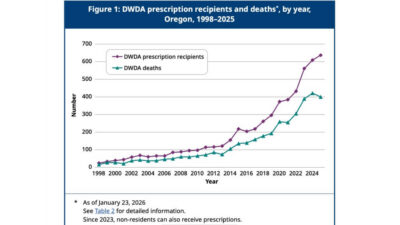
While New Zealand debates expanding euthanasia, Oregon’s latest Death with Dignity report shows prescriptions for lethal drugs reached a new record of 637 in 2025 — the highest since the law began in 1998.These latest figures show an increase of about 4.6% from the prior year, with 609 prescriptions of lethal drugs in 2024. To date, 5,520 people have been prescribed lethal drugs since Oregon’s DWDA took effect in 1997, and at least 3,691 (67%) have died after taking them, according to the OHA.

The latest annual assisted suicide report, ‘2025 Oregon Death with Dignity Act Data Summary’, released earlier this month, reveals that a total of 3,691 individuals have died by assisted suicide in Oregon since 1998. In 2025, 400 assisted suicide deaths occurred, a decrease from 421 deaths in 2024. It is likely the 400 figure will be updated, as in previous years, to include reports received after 23 January 2026. This means the final count of people who died by assisted suicide in Oregon in 20254 could be higher. For instance, in 2024, the initial report recorded 376 deaths by assisted suicide, but the mostrecent update revised this number to 421.

The report shows that, in 280 of the 400 assisted suicide deaths, there is no information on whether complications occurred. This is because data are recorded only when a healthcare provider is present at the time of death. Among the 120 cases with available complication data, seven experienced complications, such as difficulty ingesting or regurgitating the lethal substance.

According to the report, 53.5% (214) of all individuals who ended their lives by assisted suicide were female, while 46.5% (186) of them were male. What’s more alarming is that almost 2 in 5 of individuals who died by assisted suicide reported being concerned about being a burden on family, friends/caregivers.

The 2025 report states that the three main reasons that Oregonians asked for assisted suicide were: 89% Losing autonomy, 89% Less able to engage in activities that make life enjoyable, 65% Loss of dignity (an undefined concern). Alarmingly, the report reveals an absence of medical oversight, with fewer than 1% of assisted suicide deaths involving a psychiatric evaluation, and in a large proportion of cases, no medical professional was present at the time of death.

Spokesperson for Right To Life UK, Catherine Robinson, said, “It is incredibly worrying that the number of assisted suicide prescriptions in Oregon hit a record high in 2025. Assisted suicide deaths may well have hit a record high, too, if the revision of data from previous years is anything to go by. This should serve as a stark warning to all those who believe that assisted suicide remains rare”.

Oregon Right to Life Executive Director Lois Anderson stated, “Once again, Oregon’s report on assisted suicide reveals a concerning increase in prescriptions for drugs that can cause death.” She added, “Last year, instead of receiving care, support, and the reassurance that their lives have inherent worth, 637 vulnerable individuals were prescribed medications meant to end their lives.” Anderson emphasised, “This is deeply upsetting and unjust. Our elderly, disabled, and those with complex medical needs deserve true dignity and compassion, demonstrated through love, care, and support that affirms life.” She concluded, “Legalised assisted suicide conveys the message that some lives are simply less valuable, which is the wrong message to send.”

Oregon’s data shows that the ‘rare and carefully controlled’ promise is not the reality. Once legalisation occurs, reporting becomes dubious, safeguards are gradually removed, and investment in palliative care and services alike is overlooked. Oregon’s 28-year experiment should be a red flag for New Zealand lawmakers. True compassion means caring for the vulnerable — not offering them lethal drugs.

Netherlands hits record 10,341 euthanasia deaths in 2025

By | Recent News

The runaway train continues. The Netherlands has released its yearly report on euthanasia, revealing that 10,341 individuals died by euthanasia in 2025 — the highest annual total since legalisation in 2002. This represents a 3.8% increasefrom 2024, with euthanasia accounting for nearly 6% of all Dutch deaths (173,314 total deaths).

One of these deaths involved a young person aged between 12 and 18. The Regional Euthanasia Review Committee report provides no further details on the case, other than confirming it was based on a physical condition rather than a psychiatric one.

According to the report, nearly three-quarters (74.7%) of individuals who received euthanasia were aged over 70. Over 85% of cases involved common physical conditions such as cancer, disorders of the nervous system, lung conditions, or cardiovascular disease. There were 174 cases involving mental health disorders as the primary ground — 45 fewer than in 2024, a decrease of approximately 21%.

Although the majority of cases involved people over 70, 33 cases concerned individuals aged 18–30, 71 cases those aged 30–40, and 160 cases those aged 40–50. The third-largest group was people aged 60–70.

Dementia-related euthanasia cases rose by 17% in 2025, while cases involving an accumulation of age-related conditions increased by 20% (from 397 in 2024 to 475). Duo-euthanasia — where two closely related people (such as partners, siblings, or parent and child) receive euthanasia together — also rose, with 60 cases recorded, an 11% increase from 2024.

The Dutch model has long been regarded internationally as an example of a balanced and careful system, even as it includes psychiatric conditions and minors. However, since legalisation in 2002, the data show a clear, long-term upward trend. The number of official notifications has increased more than 5.5-fold, rising from under 2,000 per year in the early 2000s to over 10,000 in 2025. As a share of all deaths, euthanasia has grown from roughly 1.3% to nearly 6%.

While supporters of euthanasia may point to the relatively slow growth this year and the decreasing number of psychiatric cases, the overall trajectory remains one of steady increase. An expansion that now includes young people and a persistent rise in psychiatric and dementia-related cases is not necessarily something to celebrate. As Charles Lane has argued in The Atlantic, the Dutch experience may serve as a warning that the risks of euthanasia represent less of a slippery slope and more of a runaway train.

*Written by Family First writers*

Alberta government proposes new safeguards for medically assisted dying

By | Recent News

In just four years, deaths from assisted suicide/assisted dying in Alberta, Canada, increased by 109 percent. This is the reality Premier Danielle Smith’s government in Alberta faced when she introduced Bill 18, the Safeguards for Last-Resort Termination of Life Act, on 18 March 2026. It is also a reality that New Zealanders should pay close attention to, because Canada’s assisted suicide trajectory is linked to New Zealand’s story. It acts as a warning.

So what does the Bill actually do?

  • Restrict who qualifies – Only adults 18 and over whose natural death is likely within 12 months (Track 1) would be eligible. Track 2 MAID — for those not facing imminent death — would be banned entirely. Also prohibited: MAID for those under 18, those lacking decision-making capacity, those whose sole condition is mental illness, and advance requests.
  • Tighten the assessment process – Before assessing a patient, doctors and nurse practitioners must make reasonable efforts to contact every primary care provider the patient has seen in the past 12 months, and review all of the patient’s health and personal information.
  • Require a family witness – A family member — defined as a parent, spouse or partner, child, sibling, grandparent, or grandchild — must be present when MAID is administered, unless the provider determines one is not reasonably available.
  • Restrict what providers can say and do – Health professionals cannot raise MAID as an option with patients — the patient must bring it up first. Referrals out of province for MAID assessments would be banned. Public display of MAID information within healthcare facilities (such as posters) would also be prohibited.
  • Mandate training and enforce compliance – All MAID assessors and providers would need to meet new training requirements. Sanctions — starting with remedial training and escalating to suspension or loss of the right to provide MAID — would apply to any provider who breaches the legislation.
  • Protect conscientious objectors – Individual doctors and nurse practitioners would have an explicit legal right to refuse to participate in MAID. Certain facilities — including faith-based ones — would have the right to refuse MAID on their premises entirely, and could establish a 150-metre exclusion zone around their building where MAID services would not be permitted.

Should the bill pass, Alberta would become the first Canadian jurisdiction to place these kinds of limits on federally permitted assisted suicide deaths. The legislation would also proactively limit access to MAID in situations where the federal government has indicated it might implement changes.

Critics are framing this legislation as cruel because it forces suffering people to live against their will. However, supporters of the bill say otherwise.

Inclusion Alberta CEO Trish Bowman stated that MAID was sometimes causing medical systems to offer death as an alternative to supporting people with disabilities, rather than providing the necessary support for a better quality of life. She mentioned that Alberta’s limits could help save lives.

“We know it reinforces incredibly negative and dangerous stereotypes about the value and worth of the lives of people with disabilities. And so we’re very pleased to see this legislation today that serves to protect them,” Bowman said.

Krista Carr, CEO of Inclusion Canada, says she hopes other provinces follow Alberta’s example. However, she said the limits should also compel governments to invest more into programs and support that improve the quality of life for people with disabilities.

Canadian Mental Health Association research librarian Robert Olson called the legislation “heartening” and noted that their organisation opposes the expansion of MAID to people with mental illness.

Dr. Ramona Coelho, an Ontario family doctor who spoke at the bill’s introduction, has documented something deeply troubling in her practice: marginalised patients — people struggling with poverty, social isolation, inadequate housing — being offered assisted death instead of the comprehensive care that could actually ease their suffering. “Patient suffering can be addressed,” she said, “and their lives can greatly improve if we take that time.”

This is the heart of the bill. A refusal to let the medical system off the hook by offering death where it should be offering care.

Canada introduced medical assistance in dying in 2016, initially for the terminally ill only. By 2021, a court ruling expanded eligibility to include people who were not dying imminently. By 2024, Quebec began allowing advance requests — meaning people could arrange their death while still lucid, for a future date. And by March 2027, the federal government is scheduled to allow assisted suicide for people whose sole underlying condition is a mental illness.

Read that again. Mental illness. Alone. As grounds for an assisted suicide death.

New Zealand’s End of Life Choice Act came into force in November 2021, limiting assisted dying to adults with a terminal illness likely to end their life within six months. Canada started with similar bones.

Our law may be due for change. The pressure to expand eligibility to non-terminal conditions, to those suffering from psychological conditions, to younger people, will come. It always does. The Canadian experience shows us exactly where that pressure leads when it is not resisted.

Alberta’s Bill 18 is significant because it reflects a government willing to oppose and take action on the MAID programme, which has shown itself to be spiralling out of control – not just in Alberta but across Canada.

The solution to suffering isn’t a faster, cheaper, tidier way out. It is investing in palliative care, mental health services, disability support, and resources to assist families supporting loved ones through difficult times. That is the alternative Alberta’s own critics of the bill acknowledged was missing. That is what our most vulnerable truly need.

Now, the “slippery slope” in the euthanasia debate, whether here at home or internationally, was not merely a scare tactic; it functions as a roadmap, and we are witnessing it happen in real time. Perhaps, the better metaphor is that the slope is no longer slippery—it’s a cliff.

New Zealand must pay attention and take note.

*Written by Family First staff writers*

Scottish Parliament chooses life as assisted dying bill falls

By | Recent News

On 17 March 2026, the Scottish Parliament rejected the Assisted Dying for Terminally Ill Adults (Scotland) Bill at Stage 3, with 69 MSPs voting against, 57 voting in favour, and one abstention. The bill, introduced by Liberal Democrat MSP Liam McArthur, would have permitted terminally ill, mentally competent adults with a prognosis of six months or less to request assistance to end their lives, subject to safeguards.

In May 2025, the legislation passed Stage 1 with a vote of 70 to 56, approving its core principles. Stage 3 involved extensive debate across multiple sessions, with over 300 amendments discussed, including a late change to limit eligibility to those with a six-month prognosis.

Supporters, including McArthur and Scottish Conservative MSP Sandesh Gulhane (a practising GP who chaired the bill’s medical advisory group), argued that the bill was carefully drafted with solid safeguards. They claimed it would offer compassion and dignity to those facing terminal illness, ease severe suffering, prevent unsafe travel abroad for assisted dying, and ensure proper oversight rather than unchecked deaths.

Gulhane stated: “Choice matters. This bill represents years of work, consultation and scrutiny. It offers compassion, safeguards and dignity for those facing the end of life.”

Opponents, including disabled MSP Jeremy Balfour and some SNP and Conservative members, raised concerns about risks of coercion, especially for disabled or vulnerable people, potential pressure on individuals to avoid being a burden, and changes to the doctor-patient relationship. They argued that no safeguards could fully eliminate the risk of abuse.

Balfour, who was born without a left arm and with a shortened right arm, said disabled people felt “terrified” by the proposals and warned that the bill could open Pandora’s box with insufficient protections against coercion. “I’m begging you to consider the consequences for the most vulnerable,” he said.

Many MSPs opposing the bill emphasised the need to prioritise improvements in palliative care, social care, and protections for vulnerable groups before any change to the law.

After the vote, campaign groups on both sides issued statements. Dignity in Dying expressed disappointment but reaffirmed its commitment to pursuing reform, citing strong public support in some polls. Opponents like Right To Life UK and CARE for Scotland welcomed the result, viewing it as a safeguard for vulnerable individuals.

The bill was subject to a free (conscience) vote, with no party whips. This marks the latest in several unsuccessful attempts to introduce assisted suicide legislation in Scotland, though it progressed further than previous efforts. Attention may now (and should) shift towards improving palliative care.

*Written by Family First staff*

New Zealand is paying more to end lives than care for them

By | Recent News

A frontline New Zealand GP has exposed a troubling financial incentive at the heart of our end-of-life system — assisted dying pays up to six times more than palliative care. According to an article in Doctor NZ, Fiordland Medical Practice specialist GP Stephen Hoskin has written to Deputy Prime Minister David Seymour, raising urgent questions about why the system is structured this way, and who is responsible for fixing it.

The numbers are stark. Under his PHO, Dr Hoskin can claim $517.50 per patient for providing palliative care in the community. This covers every visit, every call, every hour spent supporting a dying person and their family. By contrast, the Te Whatu Ora website indicates a GP could claim up to $3,080 for a single assisted death. This isn’t a technical error either. This is a system that has been built (unintentionally or not) to reward ending lives over supporting them.

This isn’t a claim from a lobby group. It’s the assessment of a working rural doctor. Dr Hoskin describes the situation as “deeply concerning and unethical,” warning that even well-meaning doctors carry unconscious biases. When a patient raises assisted dying, and a doctor knows they could earn six times more by proceeding rather than redirecting towards palliative care, can we truly say that the consultation is unbiased? Dr Hoskin doesn’t think so, and neither should we.

The rural health disparities make this worse. Some palliative care visits in rural New Zealand are reimbursed at under $50 — less than the cost of a standard GP consultation, and a fraction of what urban patients may receive. Why doesn’t a dying person in Fiordland deserve the same quality of end-of-life support as someone in Wellington?  Despite the Government spending $119 million on hospice care for 2025/26, these disparities persist.

Before the End of Life Choice Act was passed, and again during its three-year review, pro-life advocates and organisations, including Family First NZ, warned that financial disparities and perverse incentives would follow. Those concerns were dismissed as scaremongering. Well, it looks like this recent exposure by Dr Hoskin confirms what we have always said — the system is not neutral. It structurally incentivises death over palliative care, and it has been doing so since the Act came into force in November 2021.

And it appears from the deflection in responses from Seymour to the Health Minister to Te Whatu Ora, no one is taking accountability for a system that Dr. Hoskin describes as “deeply concerning and unethical. While Te Whatu Ora recognises that palliative care funding is “inconsistent across New Zealand” and mentions a National Palliative Care Work Programme but provides no timeline or specific commitments.

Three deflections. Zero answers. Nobody owns this.

And the push to expand the system continues regardless. A proposed amendment bill, lodged by ACT’s Todd Stephenson, wants to make it easier for doctors to raise assisted dying directly with patients — removing one of the few remaining safeguards in the current legislation. Even more troubling, the bill includes removing the 6-month prognosis time-limit and looks to pressure palliative care facilities to participate in assisted dying services. Organisations built around the sanctity of life and caring for the dying could be compelled to facilitate death instead. Combined with the financial incentives already baked into the system, this expansion should alarm every New Zealander who cares about protecting the elderly, the vulnerable, and the dying.

A society’s priorities are revealed by what it funds. Right now, New Zealand is paying more to end lives than to cherish them.

Source: New Zealand Doctor Rata Aotearoa. All quotes and figures cited are drawn from their original reporting.


Check out our euthanasia factsheet


France pushes to open the door to euthanasia

By | Recent News

Yesterday, the French National Assembly voted on passing a bill legalising assisted dying. This marks the next phase in a year-long debate on euthanasia and assisted dying. The National Assembly voted in favour of the bill to legalise assisted dying in May 2025, but the French Senate rejected it and sent it back for further reconsideration about eight months later. Iterations to the bill have been made since, with the debate returning to the French parliament earlier in Jan, and a final vote held on Feb 25th. The final vote on the bill was 299 in favour and 226 against, with an absolute majority set at 263. Ironically, the accompanying bill on palliative care was also unanimously passed at the same time.

With steps closer to legalising assisted dying, the euthanasia bill adopts the assisted dying model, making self-administration of the lethal substance the rule and assistance from a third party the exception if the individual is unable to self-administer. This would only be available to those who meet strict eligibility criteria, which require them to be over 18 years of age, residing in France, and suffering from a life-threatening incurable illness in a terminal stage. Individuals will also need to express their wish to end their lives. If this sounds familiar, that’s because we’ve seen the same course of action here at home.

Currently, the Léonetti Law of 2005 regulates end-of-life care, permitting individuals to refuse “futile medical care” and to access palliative treatment. In 2016, the Claeys-Léonetti Law expanded these provisions, allowing deep and continuous sedation until death under specific conditions, applicable when the patient suffers unbearably and death is deemed inevitable and imminent.

Olivier de Margerie, the president of Accompanying Life Until Death, is concerned that presenting assisted suicide as an individual liberty risks pressuring people with terminal illnesses. Mr. de Margerie argues that:

“introducing the possibility of ending one’s existence — where society organises and facilitates the process — is a direction that will, in the fairly short term, lead to a reduction in the financial, political and technical efforts to develop palliative care that is available everywhere and accessible to everyone in France.”

He’s right. Once the state normalises assisted suicide and society accepts it as normal and routine healthcare, investment in compassionate alternatives inevitably declines.

Australian bioethicist and author Xavier Symons also cautions that lawmakers in different countries considering euthanasia might underestimate how eligibility criteria could broaden over time. He notes:

“The biggest risk is establishing a ‘right to die’ that could extend far beyond terminal illness, thus allowing access to euthanasia to any group that wants it,” he said. “This includes people with mental illness, people with chronic illnesses, and even people tired of life. If it is claimed that some people have the right to euthanasia, it is difficult to deny the conclusion that all people have the right to euthanasia.”

And this is the exact pattern we are seeing in different jurisdictions like France’s neighbours, the Netherlands and Belgium, and let’s not forget Canada, where assisted suicide (they call it medical assistance in dying) is the 5thleading cause of Canadian deaths. Not forgetting that each of these countries often begins with restrictions on assisted suicide, only for expansion to follow slowly and quite drastically.

Now, whilst the French National Assembly just passed the bill again, overriding the Senate’s earlier rejection and sending it back to the Senate, which is largely conservative. But the pressure to adopt euthanasia is intensifying, and France is yet another nation on the brink of institutionalising and normalising the idea that the sanctity of life only matters for some and not others.

France’s debate will be a crucial one to follow. It highlights how rapidly a society can move from defending life to enabling death—and underscores the importance of consistently advocating for genuine compassion, true dignity, and quality palliative care, rather than state-approved killing.

*Written by Family First writers*

Ethos Alliance: ACT’s euthanasia law would breach human rights

By | Recent News

ETHOS ALLIANCE PRESS RELEASE


ACT wants to expand euthanasia but this would breach fundamental human rights in the New Zealand Bill of Rights Act.

“ACT’s changes breach human rights and take away freedom of choice,” says Alex Penk, author of a new report for MPs on the End of Life Choice Amendment Bill. “The Bill would stop doctors and care facilities like hospices from using their conscience and making ethical decisions like they do now.”

“Assisted dying is already highly controversial and most doctors don’t want to be involved,” says Penk. “The Bill would introduce euthanasia for long-term conditions and disabilities, like chronic heart conditions, frailty, diabetes, renal failure, multiple sclerosis, and motor neurone disease. This would force doctors and care facilities into more conscience conflicts. Doctors have to use ethical judgment all the time but the Bill sends a message that they’re just supposed to do what the state tells them. There’s a real risk it’ll force ethically-minded people out of medicine.”

“ACT’s bill would also undermine palliative care. It would cover ‘care facilities’, including hospices, disability support facilities, and rest homes. Care facilities would have to be prepared to allow assisted dying even when that goes against their beliefs. Facilities like hospices do an incredible job for vulnerable people but they’re over-stretched and under-funded. They shouldn’t be backed into a corner if they don’t want to be involved in euthanising their residents.”

“This is not what Kiwis voted for,” says Mr Penk.  “David Seymour said that conscience is a cornerstone of the law, and 65 percent of voters supported that law in a referendum. There is no mandate to change such a fundamental part of the law. Let individual doctors and care facilities decide if they want to offer assisted dying, or the government could just do a better job of providing information.”

“It’s ironic that a law about end-of-life choice would limit freedom of choice,” says Penk. “MPs will get a conscience vote if the Bill goes before Parliament. Why shouldn’t doctors and care facilities get to use their conscience too?”

END

For more info check out: https://www.ethosalliance.nz/news-and-views

The slippery slope of organ donation and assisted dying

By | Recent News

In an opinion piece (in response to a Stuff NZ article on organ donations and assisted dying), Dr John Kleinsman of the Nathaniel Centre for Bioethics argues against combining organ donation with assisted dying in New Zealand, despite organ shortages. He highlights concerns around coercion, emphasizing the societal pressure that could make vulnerable people feel compelled to choose assisted dying or face societal expectations.

While doctors can legally refuse to participate in assisted dying, those on organ retrieval teams are inevitably connected to the process of ending life. He points out that, although the public might see ending a patient’s life and organ retrieval as separate, in practice, the medical teams must work closely together. Essentially, the organ retrieval team, whether they consent or not, will play a role in how the patient dies, making them inherently connected with the act of directly, intentionally, and prematurely ending a patient’s life. This threatens the conscientious objection rights of doctors who entered medicine to save lives, not end them, and may even exclude doctors from minority ethnic or religious backgrounds who are uncomfortable with assisted dying.

Organ recipients won’t be told if their donor died through assisted dying, which violates their autonomy. Dr Kleinsman notes that 35% of New Zealanders opposed assisted dying in the 2020 referendum, making transparency about donor circumstances crucial for respecting recipients’ right to make informed decisions.

Dr Kleinsman argues that while organ donation is normally a generous gift, the utilitarian argument of increasing organ supply by the likes of Organ Donation New Zealand (ODNZ) isn’t a sufficient justification when weighed against these ethical concerns.

*Written by Family First staff writers*

Please see here for the original article and Dr Kleinsman’s full response.
Check out our Family Matters episode with Dr. John Kleinsman

Euthanasia has surged to become one of Canada’s top killers

By | Recent News

The report indicates that cancer, especially lung, colorectal, pancreatic and blood cancer, was the most frequently reported condition in nearly all age groups of people who died by MAID in 2024, except those 85 and older, “for whom ‘other’ conditions were the most frequently cited.

Interestingly, inadequate pain control was only the sixth most common reason for seeking MAID. The primary reasons for euthanasia deaths were related to autonomy and daily function:

  • Loss of ability to engage in meaningful activities (the highest reason, over 95% for both tracks).
  • Loss of ability to perform activities of daily living.
  • Loss of independence and loss of dignity

Figure: Reported nature of suffering, by track

Source: Sixth annual report: Medical assistance in dying Canada

In terms of MAID deaths across districts, Quebec has the highest number of euthanasia deaths at 5,998.  MAID deaths remain heavily concentrated in three provinces, which accounted for nearly 85% of all provisions: Quebec (36.4%), Ontario (4,944 deaths, 30.0%) and British Columbia (2997 deaths, 18.2%).

Nearly all MAID deaths were performed by a doctor or nurse practitioner. While the law allows patients to self-administer the medication in most parts of the country (except Quebec), this option is rarely chosen. The typical (median) age of a person receiving MAID in 2024 was about 78 years old. Recipients who were near the end of their lives (Track 1) had a median age of 78.0 years, while those whose death was not immediately foreseeable (Track 2) were slightly younger, with a median age of 75.9 years. Overall, the average age of MAID recipients continues to rise slightly each year.

There was a notable increase in track 2 euthanasia deaths, which increased by 17% accounting for 4.4% of total euthanasia deaths and up from 4.1% in 2023. Track 2 euthanasia deaths refer to not immediately foreseeable deaths of people and are more likely not to have a terminal condition, to be women, younger and living with a disability.

Dissecting Track 2 euthanasia deaths a little further, it appears people who die by Track 2 euthanasia deaths are significantly more likely to be poor, live in institutions or poor neighborhoods, and be receiving disability support services than those who die under Track 1. Of the 16,104 people who responded to questions around disabilities, roughly one-third (32.9 per cent) reported having a disability.

Alex Schadenberg, chair of the Euthanasia Prevention Coalition (EPC), suggests that MAID for non-terminal conditions mainly targets individuals with disabilities, noting a clear link between disability and Track 2 deaths, as 61.5% of Track 2 recipients identify as disabled.

If that isn’t shocking enough, loneliness and isolation were reported as a factor in 44.7% of Track 2 deaths and 21.9% of Track 1 deaths, suggesting that over 3,800 people listed this as a primary reason. Track 2 recipients were far more likely to be receiving mental health/social support services (31.4%) compared to Track 1 recipients (9.4%), indicating that mental health is a prevalent factor in non-terminal MAID cases.

These statistics are both disturbing and tragic, highlighting pro-life advocates’ concerns about expanding Canadian euthanasia laws to include non-terminal individuals. These vulnerable groups are often affected by factors such as lower socioeconomic status, disabilities, and insufficient social support. The recent MAID data confirms this, showing that social and systemic problems—like loneliness and inadequate disability support—are significant factors influencing requests for MAID.

The most concerning finding in the 2024 Annual Report is not only the total number of MAID deaths but also the speed at which this peak was reached. Despite the growth rate slowing to 6.9% in 2024, this follows years of swift expansion that propelled Canada from having a recently legalized system to becoming a global leader in euthanasia deaths. This trend confirms that MAID is shifting from a last-resort service to a major—and quickly becoming a leading cause of death in Canada.

*Written by Family First writers*

Simon O’Connor: Speaking to the House of Lords on Euthanasia

By | Recent News

This week I found myself up at 4am to speak to the House of Lords in the United Kingdom.  As you may know, they are considering yet another euthanasia/assisted suicide Bill and the Lords are currently holding committee hearings and wanted to know of the New Zealand experience.

There were four of us in total, two supporting life and palliative care and two that either support or lean in support of euthanasia.  I was there alongside Professor Sinead Donnelly, a professor and palliative medicine physician. Naturally, I’m with Family First, but I was also there, having chaired the health committee in parliament when it then undertook the largest ever inquiry, that into euthanasia.

I will admit, it was both a very early and long morning.  The way the House of Lords operates means that just about every vote requires the Lords to be there in person, so bells would ring during the hearing, and they would have to leave!

My message to the Lords was simple – euthanasia laws inevitably expand.  There was a sense from some of the Lords (those in support of euthanasia) that their UK law would be exceptional, that, unlike other countries, their proposed law would be complete and never need to be changed.

I simply pointed out that every jurisdiction that introduces euthanasia laws sees expansion.  I pointed out that we are only three years in here in New Zealand, and already, there is a big push to expand the law.  To remove conscience rights from doctors, nurses, and hospices; to let doctors promote euthanasia to patients; for the Ministry of Health to advertise euthanasia; and to remove the likely 6 months to live requirement.

The key dynamic in play, that I attempted to succinctly explain to the Lords, was the euthanasia moves swiftly from being a health issue to a justice issue.  Debate begins around terrible medical conditions (think neurological disorders such as Huntington’s disease) but swiftly moves to one about rights, not discriminating, and equal access.

I was also at pains to point out the contradictory statements being made by the New Zealand pro-euthanasia witnesses.  On one hand, they were saying New Zealand’s law has important safeguards yet the very next minute they were saying that safeguards are an obstruction and prohibition that should be removed.  Quite extraordinary!

A particularly memorable moment, which elicited loud gasps from the Lords present, was when one of the pro-euthanasia researchers here in New Zealand stated:

“The concerns about palliative care being undermined are more about the palliative care professionals who cannot sit with their own discomfort about assisted dying”

You can appreciate why there were gasps to this dismissive and dangerous statement.  What was being strongly stated is that any moral or ethical concerns around terminating people should be put aside; that palliative care practitioners with concerns should be dismissed.  This New Zealand researcher also appears blind to why people might experience such discomfort, and doubly so when it’s those in palliative care who spend their lives trying to help the dying live well to the very end.

Let’s hope that the Lords see the value of life and vote no to this proposed law.