Media Release 16 July 2020
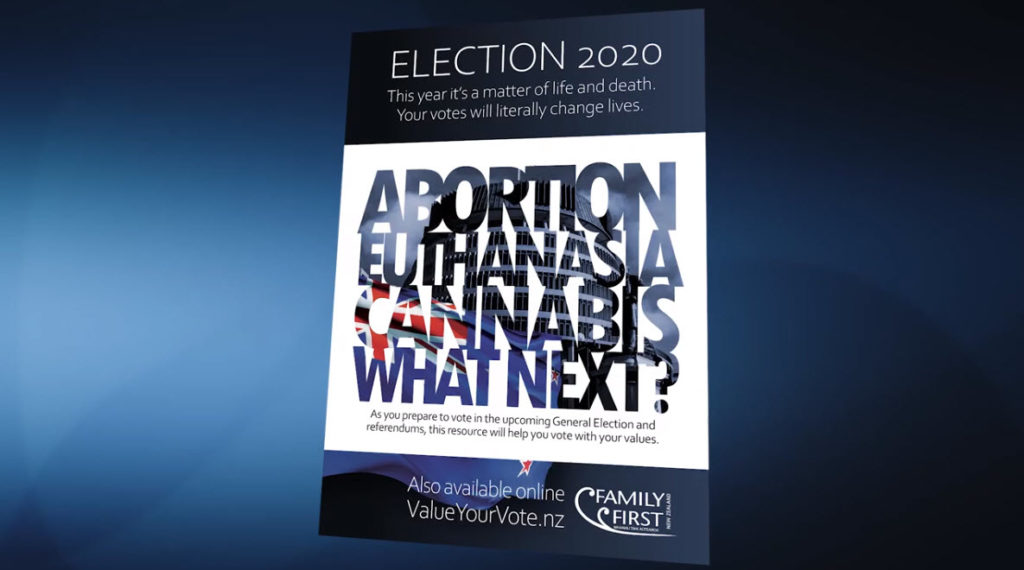
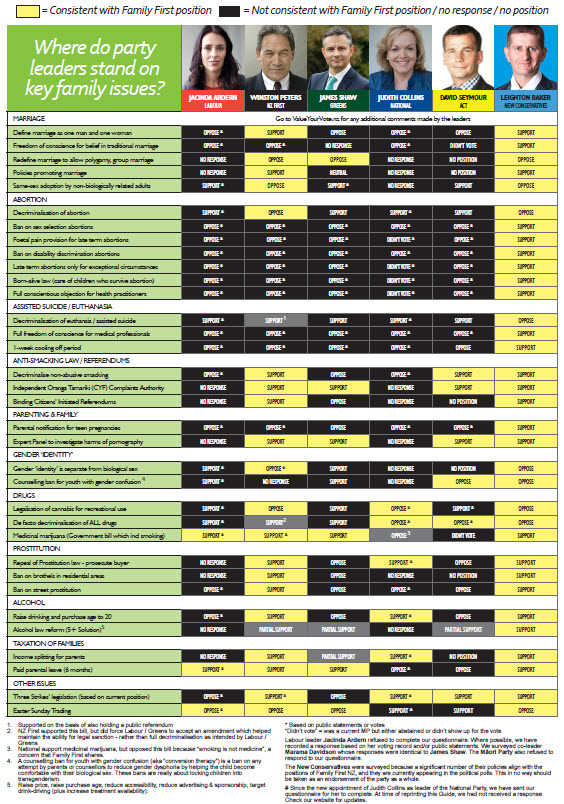
Hot off the press is our brand new resource Value Your Vote 2020. This is the fifth election where we have provided this popular voting resource for families.
The 2020 election is unique in that we not only have two votes under the MMP system, the party vote and the electorate vote, we also get another two votes: on whether euthanasia and cannabis should be legalised in New Zealand.
Your votes will literally change lives.
This brochure (and the accompanying guide on our website – ValueYourVote.nz) does two things:
1. It allows you to see how each MP, including each party leader, has voted on important social issues. Many of them are conscience votes, allowing an MP to vote according to his or her conscience rather than along party lines. However, in many cases, there seems to be a ‘party conscience’.
2. It explains the reasons why a NO-vote in both the referendum on cannabis and the referendum on euthanasia is the only option.
There is also a summary of why the new abortion law should never have been passed.
Watch the short promo below….
The resource is also available to be viewed and downloaded in Maori, Samoan, Tongan, Arabic, Korean and Chinese.
VOTING ACCORDING TO OUR VALUES IS THE GREATEST FREEDOM AND PRIVILEGE WE HAVE. WE SHOULD VALUE IT – AND USE IT!
We are pleased to aid you in making an informed decision when you vote this September.
NewsHub 12 July 2020 Family First Comment: There are so many crucial points made in this piece that it’s difficult to know which bit to highlight. So take the time to read it all! As Rhona Winnington – a registered nurse, sociologist and lecturer at the Auckland University of Technology (AUT) – concludes: “We need to safeguard our families and communities from these social consequences of assisted dying legislation. Vulnerable populations have to remain safe from persuasion to die and there has to be a supportive framework for those left behind after an assisted death, so they can grieve without feeling stigmatised.”
When New Zealanders go to the polls in September, they will also be asked to vote in a referendum on assisted dying.
Parliament already passed the End of Life Choice Act in 2019, but the referendum will decide whether it comes into force.
We will be asked if we accept or decline the right of people to seek an assisted death, without the need for consultation with family and with no stand-down period other than a requirement of 48 hours to prepare the medication. The act would allow people to choose when they die and by what means, whether the medication is self-administered or given by suitably qualified clinicians.
This appears an ideal scenario, affirming the right to choose, but it is a deeply profound decision for the public to make. Many may be unaware of issues beyond the goal of ending suffering for people with life-limiting conditions.
My research shows an assisted death can have repercussions for many people – those left behind or others struggling with a chronic disease. Experiences from countries where assisted dying has been legal for some time have highlighted these challenges.
Social consequences of assisted dying
In the Netherlands, assisted dying has been legal for 18 years. Over time, there have been notable slips in the criteria that have to be met. This includes the level of physical suffering, which is a subjective experience, and the requirement that people must be competent to agree to an assisted death at the point of administration. This may not be possible for people with dementia who have previously given written consent but can no longer consent at the point of death.
While the law hasn’t changed, its interpretation has, and people with mental illness can now also request an assisted death. Data from the Netherlands show one in 30 people now die by euthanasia, compared to one in 90 when the law was introduced in 2002.
In the US, some medical insurance companies pay for an assisted death but not for palliative care. This removes any notion of choice and autonomy from the person.
NewsRoom 10 July 2020 Family First Comment: An important commentary…. “I read headlines stating the majority of public (63%) support legalising euthanasia, according to the poll. To the untrained eye, that looks like some strong evidence that the End of Life Choice Act (EOLC Act) is a done deal. But to me it just smacks of the same shallow approach to this vote that many are tempted into making. Hold that poll up against other polls that show 74% of Kiwis don’t know we can already turn off life support, 70% incorrectly think the EOLC Act will legalise the choice not to be resuscitated (which is already legal), and 75% thought it would only be available when all other treatments have been tried… so I wonder what information we are basing our poll voting on?
Most Kiwis aren’t aware that the end of life choice act is not a concept they’ll be voting for, but specific, unmovable legislation. And if we make a mistake, death is a heavy penalty, writes Caralise Trayes.
A new Colmar Brunton poll revealed last weekend doesn’t do any favours in helping people recognise the binding referendum question they will actually be asked at this year’s election. It only reinforces the point that Kiwis aren’t being equipped to make an informed vote.
I read headlines stating the majority of public (63 percent) support legalising euthanasia, according to the poll. To the untrained eye, that looks like some strong evidence that the End of Life Choice Act (EOLC Act) is a done deal. But to me it just smacks of the same shallow approach to this vote that many are tempted into making.
Hold that poll up against other polls that show 74 percent of Kiwis don’t know we can already turn off life support, 70 percent incorrectly think the EOLC Act will legalise the choice not to be resuscitated (which is already legal), and 75 percent thought it would only be available when all other treatments have been tried… so I wonder what information we are basing our poll voting on?
Us Kiwis need to know we will in fact be voting on a very specific piece of legislation; not the concept of euthanasia. If we vote ‘yes’ in the binding referendum, the law is passed and active. No changes or adjustments can be made to this Act. So we should be examining the piece of law in front of us. However hard it is, we must put aside our view on the topic of assisted dying, and check this is the right law for the job.
We need to carefully assess and analyse this law to ensure it allows the autonomy to choose – something that many of us seek, while protecting those who shouldn’t have access, for one reason or another. And there’s no space for error – if we get it wrong, death is a big penalty.
READ MORE: https://www.newsroom.co.nz/no-room-for-error-on-assisted-dying
Radio NZ News 28 June 2020 Family First Comment: This new book is worth checking out… “[This bill] is intended for very few, the extreme cases probably. I assumed that the people we would be offering this to would be in extreme pain. But internationally, where assisted suicide is legal the motivational reasons for people using this isn’t actually pain. In Oregon, 2019 research shows that the primary motivational factor for people choosing this: 90 percent of people use this because their life is no longer enjoyable, 59 percent are saying they’re worried about being a burden on other people, and only 33 percent are actually in pain, or they’re afraid of the pain.”
The End of Life Choice Act will be put to the vote in a referendum alongside the national election, and has already been a hot subject of debate as it made its way through parliament.
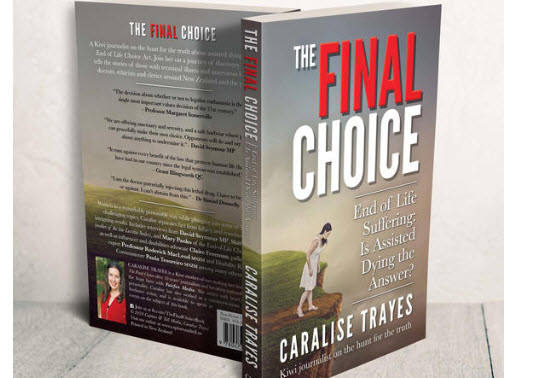
The difficult topic has been explored in a book by journalist Caralise Trayes: The Final Choice, which includes interviews with medical and legal experts, religious leaders, ethicists, and experts on the practice of voluntary euthanasia in other countries.
Trayes’ interest in the debate was pricked when she took a freelance job focused on a meeting where assisted dying was discussed.
“I came away thinking I know very little about this, but what I do know is I’m going to have to vote on this binding referendum and make a really difficult choice. We all come into this discussion and decision with our own personal experiences, what we’ve seen and how other people have died – and that’s a really hard thing to look through.
“So I did some research and the further I got into the issue the more I realised how intricate it is and how many levels there are to it. I came away with questions … and there’s so much misinformation and so much emotion out there, I think it’s hard to find good information to make sure you can make a good choice – it’s really to equip people to make good choices.”
Trays says she can’t call which direction the referendum will fall in September.
“I know that right now, somewhere between 58 and 74 percent of Kiwis sit very on the side of voting for it, but what I’ve also seen is that same proportion of people don’t know much about this.
Stuff co.nz 17 June 2020 Family First Comment: Significant concern for groups like Hospice NZ… “The judge said hospices and other organisations could refuse to provide assisted dying services. But there also had to be a way for health practitioners to meet their obligations if asked by someone in the care of the hospice or organisation. It was not for the court to suggest ways those two positions could work together, the judge said. One of the questions was whether Crown funding for hospices could be declined if they were not offering assisted dying because of conscientious objection. The judge said questions about funding would have to await a case where the funding process was in issue.” And Hospice will pay the cost! Lose lose.
A judge says it’s too early to clarify how conscientious objection rights for assisted dying might work in hospices.
Hospice New Zealand, an umbrella organisation for all hospice services, wanted answers about how conscientious objection would operate if the End of Life Choice Act was accepted in the referendum in September.
It hoped the answers would help inform debate on the referendum, and it wanted voters to be clear what they were being asked to decide.
Hospice NZ was opposed to euthanasia or assisted suicide and a cornerstone of its care was to neither hasten nor postpone death.
It took a case to the High Court in Wellington asking for declarations on the legal position but Justice Jill Mallon said in general the questions could not be decided until the issues arose against particular facts.
TVNZ One News 15 June 2020 Family First Comment: Legalising euthanasia would simply exacerbate the potential threat to vulnerable people.. “most cases are psychological, with elderly socially isolated, bullied and humiliated…. the majority of abuse comes from family members”
Up to 10 per cent of people aged 65 and over experience some form of abuse in New Zealand.
The figure comes as the country marks the beginning of elder abuse awareness week.
Around 50 per cent experience financial abuse, where people fail to repay loans or simply take money or possessions.
But most cases are psychological, with elderly socially isolated, bullied and humiliated.
Hanny Naus of Age Concern says the majority of abuse comes from family members.
“Over 2500 cases in the past year that we see, the majority are family members and so it’s not just as easy as saying, ‘I don’t want that person in my life anymore because they’re doing something to harm me,’” says Ms Naus.
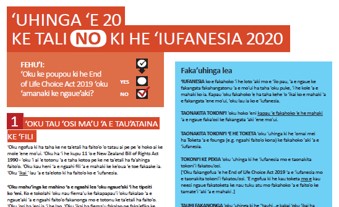
Ki he kau poupou, kaunga maheni mo e kainga Tonga kotoa pe:
Malo e lelei! Koe’uhi ko e teuteu fakaha loto mahu’inga (referendum) ‘a e fonua ‘i Sepitema ‘o e ta’u ni fekau’aki mo e maliuana mo e ‘iufanesia, kuo mau teuteu’i ai ‘a e ngaahi tohi fakamatala mahino mo lelei ma’a hotau ngaahi famili, maheni mo e siasi fekau’aki mo e ongo kaveinga ni. Pea ‘oku ta’etotongi fokii!! ‘Oku ma’u atu ‘eni ‘i he WWW.REJECTASSISTEDSUICIDE.ORG.NZ/translations/ ke mou lau mo vahevahe atu!
“‘Uhinga ‘e 20 ke tali NO ki he ‘iufanesia”
Fakapapau’i ‘oku ke mahino’i ‘a e ongo kaveinga pea ke toki fili!
‘Ofa atu,
To our Tongan supporters and friends:
Malo e lelei. In preparation for the upcoming referendum on euthanasia, we’ve prepared the perfect resource for your families, friends and church groups.
And they’re free! Download them today – and share.
“20 Reasons to Vote No to Euthanasia”.
E fa’atalofa atu i le tatou aiga Samoa potopoto.
A’o loma palota fa’alaua’itele o le Fa’aumafilēmuina (Euthansia) ua matou tapena ai ni tusitusiga e fa’amatala ma fa’amalamalama ia matāupu mo lou aiga, uō ma ē masani, fa’apea fo’i ma Fatafaitaulaga ‘ese’ese o le tatou nu’u.
O nei tusitusiga e lua, e leai se totogi mana’omia. E maua lau kopi i le ‘upega tafa’ilagi’ ua tusia i lalo.
Tusi: 20 filifiliga e tatau ai ona e palota “LEAI’ i le Fa’aumafilēmuina! Maua lau kopi mai le: WWW.REJECTASSISTEDSUICIDE.ORG.NZ/translations/
To our Samoan supporters and friends:
Talofa. In preparation for the upcoming referendumon euthanasia, we’ve prepared the perfect resource for your families, friends and church groups.
And they’re free! Download them today – and share.
“20 Reasons to Vote No to Euthanasia”.
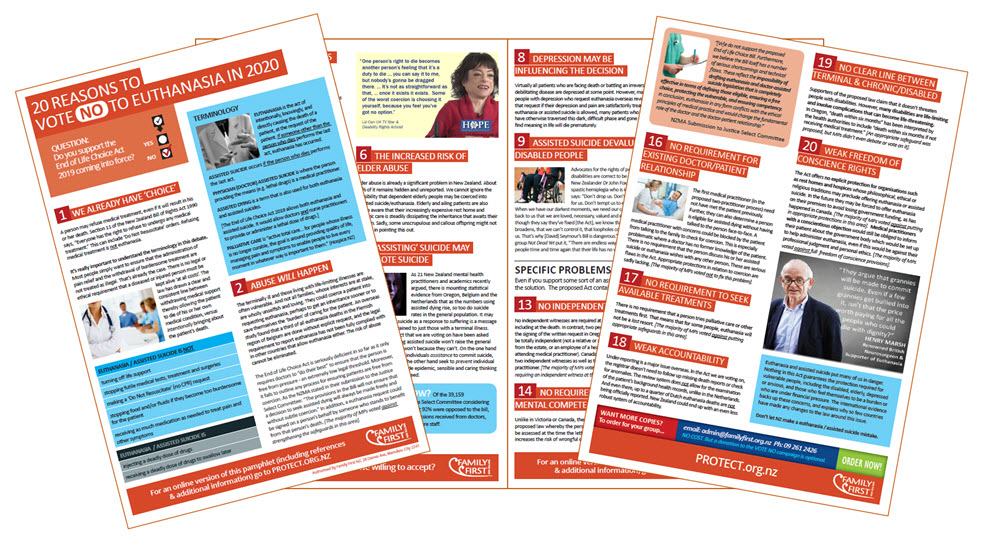
Media Release 13 May 2020
As the country prepares to vote in a referendum on whether to legalise euthanasia / assisted suicide, a new resource presents 20 reasons for New Zealanders to vote NO in the upcoming referendum.
“20 Reasons to Vote NO in 2020” include:
* we already have choice
* abuse will happen
* diagnosis and prognosis can be wrong
* ‘assisting’ suicide may promote suicide
* assisted suicide devalues disabled people
* medical bodies oppose it
and many more.
There is also an analysis of the legislation which would come in to effect if the majority of New Zealanders voted yes.
The information is available as a 4-page pamphlet for free download. DOWNLOAD HERE. This resource will be distributed widely throughout the country.
“This information will help New Zealanders understand what the debate is really about. There were attempts by MPs to correct the name of the bill to ‘Euthanasia and Assisted Suicide Act 2019’, in order to truly reflect what the law change is about, and which would allow the public to understand what practices are made legal by the passing of the Bill. But this was voted down by a majority of MPs. Rather than the referendum question simply being “Do you support euthanasia & assisted suicide?” which is what the real debate is about, they have made the question “Do you support the End of Life Choice Act”,” says Bob McCoskrie, National Director of Family First NZ.
“It completely avoids the terms ‘euthanasia’ & ‘assisted suicide’, and accentuates ‘choice’ – but as is explained in the pamphlet, we already have choice. In fact, the New Zealand Medical Association (NZMA) says that euthanasia and assisted suicide are “unethical and harmful to individuals, especially vulnerable people, and society”.”
“Euthanasia and assisted suicide put many of us in danger. Nothing in the proposed law guarantees the protection required for vulnerable people, including the disabled, elderly, depressed or anxious, and those who feel themselves to be a burden or who are under financial pressure. The international evidence backs up these concerns, and explains why so few countries have made any changes to the law around this issue.”
“We will do everything we can to prevent New Zealand from making a euthanasia / assisted suicide mistake.” ENDS
Euthanasia referendum: All you need to know about what your vote means NZ Herald 25 April 2020 Family First Comment: “The safeguards are inadequate, the principle is unsound. And I think underneath all of this is a frightening fear of what it is to be disabled. People say ‘I don’t want to be wiped, I don’t want to drool, to be dependent. To me, that’s saying ‘I don’t want to be you’. I have a huge problem with that.” #rejeactassistedsuicide Protect.org.nz
What are the arguments against?
Many of the arguments against euthanasia also came from deeply personal experiences, including people with debilitating conditions who had recovered to live a long, fulfilling life.
One of the main concerns raised by opponents was that a law change would make disabled and elderly people more vulnerable. They could be pressured into ending their lives, possibly by family members who were exhausted by looking after them, fed up with the costs of care or medicine, or who wanted their inheritance earlier.
Older or disabled people could feel a “duty to die” because they believed they were a burden on their families.
Anti-euthanasia groups said it was simply not possible to safeguard against abuse or wrongful death. Protections which might seem strong in theory had never been tested by the realities of underfunded health systems or stressed families.
Governments could use assisted dying to save health costs. And euthanasia could worsen existing discrimination against poorer or Maori and Pacific families.
Another common argument was the slippery slope, which is mostly based on the experience in the Netherlands and Belgium, where euthanasia was extended to younger people after initially being limited to adults. Opponents say broader laws may not need Parliamentary approval, and instead could be gained through a court challenge.
There was concern about the absence of a stand-down period between first deciding to get euthanasia and when it can occur. “It would be possible for a person to receive a diagnosis of terminal illness on a Wednesday, gain the necessary approvals under the bill that same day, and be dead before the weekend,” said National MP Chris Penk, one of the bill’s most vocal opponents.
Some doctors objected to the change, saying it went against their core principle of not doing harm. They were also concerned about how difficult it was to accurately predict when a person might die, and the potential for misdiagnosis.
Some felt that the law change went against the Maori worldview, in which care and respect is shown for elderly and sick people and life and wairua are valued. Religious groups argued that life was sacred and that only God should decide life or death.
How does it compare to other countries?
New Zealand would become the sixth country in the world to legalise euthanasia or assisted dying. Several states in the United States and Victoria in Australia have also legalised.
New Zealand’s legislation is stricter than in the Netherlands and Belgium. The Netherlands allows people as young as 12 to request assisted dying, and it is available to non-terminal patients. Belgium has no age limit for children, but they must have a terminal illness to qualify.
Canada and the state of Victoria have similar regimes to New Zealand, limiting euthanasia to terminal people with six months to live – though Victoria extends that threshold to 12 months if the person has a degenerative neurological condition. Both Canada and Victoria also have stronger safeguards than New Zealand, because they require written confirmation from witnesses that a person is expressing their free will.
Victoria and some US states also have a “cooling off” period, or minimum time between a person deciding to die and when it can occur.
The Ministry of Justice has not done any analysis on how many people might apply for euthanasia if it were legalised. In a comparable jurisdiction, Victoria, demand far exceeded expectations. It was predicted that one person a month would choose to end their life, and since it has been introduced the rate has been closer to two a week.
‘THE SAFEGUARDS ARE INADEQUATE’
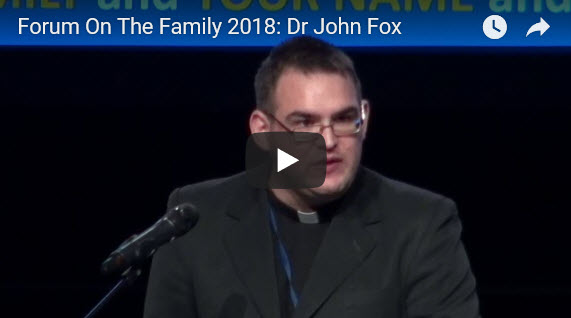
As an Anglican priest and disability advocate, Dr John Fox has been at a few deathbeds.
“I know what disabled life and disabled death looks like and the fairly severe sense of vulnerability that one has,” he said.
Fox, from Christchurch, will vote against the euthanasia referendum this year, saying it puts disabled people and others at risk.
“The safeguards are inadequate, the principle is unsound. And I think underneath all of this is a frightening fear of what it is to be disabled.
“People say ‘I don’t want to be wiped, I don’t want to drool, to be dependent. To me, that’s saying ‘I don’t want to be you’. I have a huge problem with that.”
The 37 year-old has a painful neuromuscular condition called spastic hemiplegia, and believes this would have qualified him for assisted dying under the originally drafted End of Life Choice Act. Eligibility for assisted dying in the legislation has now been narrowed to terminal patients with six months to live.
Fox said no matter how strict the safeguards were, legalising euthanasia meant that there was a fundamental shift to accepting that some lives were “not worth protecting”.
If the circumstances were extreme enough, anyone could understand why euthanasia could work in principle, he said.
“But we’re not talking about a thought experiment in a philosophy class. What we’re talking about is an actual category of people and it will be applied down at Middlemore Hospital in real life, in a place where funding is short, where there are bureaucrats and forms and power dynamics and difficulties.”
Even if he were not religious, he would oppose the bill on moral grounds.
“What I would ask people to think about is what disabled life and death is worth. My position is that if you wouldn’t do it to a rugby player, if you don’t do it to Dan Carter, you shouldn’t do it to me.”
READ MORE: https://www.nzherald.co.nz/nz/news/article.cfm?c_id=1&objectid=12318255 (behind paywall)





 To our Tongan supporters and friends: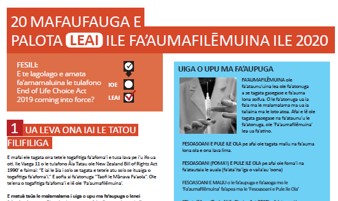
 To our Samoan supporters and friends: