All Posts By

Ed

Narelle Henson: Complex matters of life and death

By | Recent News

Stuff co.nz 15 September 2017
Family First Comment: “If our fight against suicide is to be effective we simply must be able to explain why some physical suffering justifies death while the mental torture that is severe depression, or bipolar, or schizophrenia, does not. Don’t all involve horrendous, prolonged mental or physical pain? Don’t all involve loss of dignity at certain points? Don’t all involve loss of quality of life? Don’t all involve a shortened life expectancy?
When compassion means allowing some to choose death to relieve suffering, how can it also mean convincing others to live through it?
If we cannot answer these questions, then surely, we have to face the fact that what we are fighting with one hand, we are feeding with the other.”
OPINION: One week out from a general election, our politicians just can’t seem to stay away from life and death issues.
Last week, it was abortion. This week, National MP Simon O’Connor got himself into hot water over the issue of euthanasia. He criticised the Labour leader for supporting both a zero suicide rate and euthanasia laws.
His boss, Bill English, texted him to tell him he was wrong to link the two, which makes you wonder whether English actually read the report on euthanasia that O’Connor, along with politicians of other stripes, produced recently.
On page 43 the report deals explicitly with the arguments differentiating suicide from euthanasia. The section points out that one of the world’s most important health organisations recognises that it is actually very difficult to do so.
“The World Health Organization acknowledges significant definitional difficulties in its most recent publication on the issue”, we read. “In its 2014 report, ‘Preventing Suicide: A global imperative’, it defines suicide as the act of deliberately killing oneself.”
That definition describes precisely what New Zealand euthanasia laws will aid people to do.
READ MORE: https://www.stuff.co.nz/waikato-times/96866345/narelle-henson-complex-matters-of-life-and-death

facebook_icon

Two-thirds of Kiwis in favour of euthanasia for patients with terminal illness, Vote Compass results show

By | Recent News

TVNZ One News 15 September 2017
Two thirds of New Zealanders are in favour of euthanasia, when it comes to patients with terminal illnesses.
That’s according to data from 1 NEWS’ online election tool Vote Compass.

The results show 68 per cent of voters agreed, or strongly agreed with the statement: “Patients with terminal illnesses should be allowed to end their own lives with medicinal assistance“.
Dr Jennifer Lees-Marshment from the University of Auckland told 1 NEWS that the majority of National supporters were in favour of it.
That’s in contrast to National leader Bill English’s stance that he wouldn’t support the End of Life Choice Bill, which is set to be debated following the election.
“Sixty-five per cent of National supporters support euthanasia,” Lees-Marshment said.
“Again it’s further evidence of how volatile [the election] is. We really, at this stage, cannot predict how the actual vote is going to go.
“Because public opinion is very diverse, very unexpected in some ways.”
Nineteen per cent of participants were opposed to euthanasia, with 12 per cent neutral, and 1 per cent undecided.
The results follow a Colmar Brunton poll in July, which found 74 per cent of eligible voters supporting euthanasia.
https://www.tvnz.co.nz/one-news/new-zealand/two-thirds-kiwis-in-favour-euthanasia-patients-terminal-illness-vote-compass-results-show

signup-rollKeep up with family issues in NZ.
Receive our weekly emails direct to your Inbox.

How the Media Promote (Some) Suicides

By | Recent News

First Things 1 September 2017
Family First Comment: An excellent insight…..
“When some suicides are promoted in media, law, and popular culture as a social good—as assisted suicides are—that can have an unintended effect on suicidal people who do not qualify for “assistance” under the law….
“Due in part to the media’s promotion campaign, suicide has become a siren song attracting the ill, aged, and despairing, while potentially endangering the lives of suicidal people whose circumstances are—for now—outside official “death with dignity” paradigms.”
This is precisely why the media’s glamorization of assisted suicide is so harmful. Take the example of Brittany Maynard. Most readers will recall that Maynard, a beautiful young woman, attained international A-list celebrity status when she decided to commit assisted suicide after contracting terminal brain cancer. People declared her a hero in a cover story:

For the past 29 years, Brittany Maynard has lived a fearless life—running half marathons, traveling through Southeast Asia for a year and even climbing Mount Kilimanjaro. So, it’s no surprise she is facing her death the same way. On Monday, Maynard will launch an online video campaign with the nonprofit Compassion and Choices, an end-of-life choice advocacy organization, to fight for expanding Death with Dignity laws nationwide.

The madness didn’t end there. CNN named her an “extraordinary person” of 2014: “Her example sparked a widespread debate about the rights of people with incurable illnesses to determine how and when they will die. Maynard followed through on her plans in November, dying on her own terms.” The message is clear: Dying naturally is for chumps. Living with significant limitations is undignified. Assisted suicide is courageous.
The most recent example of this phenomenon comes out of the Netherlands, where an elderly couple received joint euthanasia. There was a time, not so long ago, when the suicides of elderly couples were considered a tragedy. Not anymore. Notice the admiring tone of the Washington Post story describing the deaths:

Nic and Trees Elderhorst knew exactly how they wanted to die. They were both 91 years old and in declining health. Nic Elderhorst suffered a stroke in 2012 and more recently, his wife, Trees Elderhorst, was diagnosed with dementia.…Neither wanted to live without the other, or leave this world alone.

So the two, who…had been together 65 years, shared a last word, and a kiss, then died last month hand-in-hand—in a double euthanasia allowed under Dutch law, according to [the Dutch newspaper] De Gelderlander. “Dying together was their deepest wish,” their daughters told the newspaper, according to an English translation.

Such media plaudits have the potential to hurt others. Kheriaty provides an example:

The case of fourteen-year-old Valentina Maureira, a Chilean girl who suffered from cystic fibrosis, illustrates both effects while highlighting the power of social influences. Maureira made a YouTube video begging her government to legalize assisted suicide. She admitted that the idea to end her life began after she heard about the case of Brittany Maynard, the twenty-nine-year-old woman who campaigned for the legalization of assisted suicide before ending her own life.

Maureira did not have access to assisted suicide, because it was illegal in Chile and she was a minor. Good thing. She changed her mind after another patient with cystic fibrosis intervened and convinced her that her life was worth continuing. Had Maureira been able to find help committing suicide before then, she never would have known that she would later have wanted to live.
But that doesn’t resonate. Showing the media’s lack of true empathy, Kheriaty writes, “Her father complained that the media were only interested in her story when she wanted to die.”
If you doubt my thesis, compare the reportage about the death of Lauren Hill, a young woman who died naturally of the same cancer that caused Maynard to pursue and promote suicide. Hill struggled to continue playing college basketball—which garnered some coverage in the sports press—and raised money for cancer research. Yet despite promoting a far more positive life-with-dignity message than Maynard did, Hill received an obituary in People of only 196 words. People devoted 1196 laudatory words—huge for that publication—to Maynard in the wake of her suicide, clearly violating the World Health Organization’s media guidelines that outlets not glamorize suicides.
Due in part to the media’s promotion campaign, suicide has become a siren song attracting the ill, aged, and despairing, while potentially endangering the lives of suicidal people whose circumstances are—for now—outside official “death with dignity” paradigms.
READ MORE: https://www.firstthings.com/web-exclusives/2017/09/how-the-media-promote-some-suicides

signup-rollKeep up with family issues in NZ.
Receive our weekly emails direct to your Inbox.

Bob McCoskrie: Assisted suicide is still a form of suicide

By | Media Releases

Newshub Online 13 Sep 2017
http://www.newshub.co.nz/home/health/2017/09/bob-mccoskrie-assisted-suicide-is-still-a-form-of-suicide.html

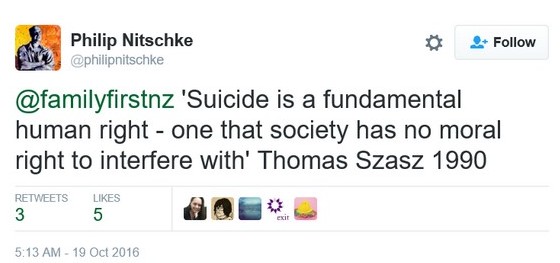
In a recent exchange with Family First. Nitschke tweeted; ‘Suicide is a fundamental human right – one that society has no moral right to interfere with’.

I find that attitude highly disturbing.

In 2014, euthanasia advocate Dr Philip Nitschke came under fire from two Australian suicide prevention organisations, Beyond Blue and the Black Dog Institute, after his involvement in the suicide of a physically healthy 45-year-old Australian man. In 2009, a Wellington woman ended her life with Nembutal, after receiving advice on how to obtain it from Dr Nitschke. She was a life-member of EXIT and was suffering from depression, but was physically fit and not suffering a terminal illness.

Many people believe that the promotion of assisted suicide is a message that will be heard not just by those with a terminal illness but also by anyone tempted to think he or she can no longer cope with their suffering – whatever the nature of that suffering.

And this appears to be the theme of the Facebook post by National MP Simon O’Connor – even if it was clumsily expressed.

Yet another MP Chester Borrows was even more blunt recently. “We have a horrific record on suicide and I think it sends a message that sometimes it is okay to top yourself. And I disagree with that.”

An analysis of the 21,000-plus submissions to the Select Committee considering euthanasia over the past 12 months found that almost a quarter of submissions opposing euthanasia were concerned about mixed messages being sent about suicide to the young and disabled.

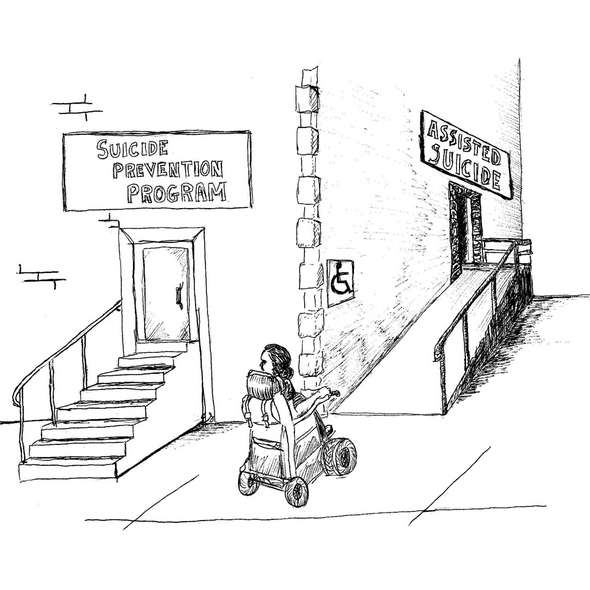
You don’t discourage suicide by assisting suicide.

There is a ‘social contagion’ aspect to suicide – assisted or non-assisted – and we need more discussion about suicide prevention, not euthanasia.

Laws permitting assisted suicide send a societal message that, under especially difficult circumstances, some lives are judged to be not worth living — and that suicide is a reasonable or appropriate way out of dealing with suffering.
The Scottish Parliament considered this issue when considering the introduction of an assisted suicide bill in 2015 and said :

“The Committee is concerned that this has the potential not only to undermine the general suicide prevention message by softening cultural perceptions of suicide at the perimeters, but also to communicate an offensive message to certain members of our community (many of whom may be particularly vulnerable) that society would regard it as ‘reasonable’, rather than tragic, if they wished to end their lives.”

Protracted discussion and the promotion of assisted suicide / euthanasia and related cases will – even unintentionally – undermine the suicide prevention message and goals in the following ways:

  • legalised assisted suicide can imply that the promotion of mental health and wellbeing for people in pain is futile or counterproductive, and that suicide is their best outcome
  • it would normalise positive portrayals of suicide in the public domain. People contemplating suicide may justify doing it based on positive stories and arguments they have heard about assisted suicide
  • it would ignore the possible harmful effects on families / whanau

The World Health Organization notes the scholarly research on the imitative nature of suicide:

“Systematic reviews of these (50) studies have consistently drawn the same conclusion: media reporting of suicide can lead to imitative suicidal behaviours.… Particular subgroups in the population (e.g., young people, people suffering from depression) may be especially vulnerable to engaging in imitative suicidal behaviours.

It can feed into people’s fears about dying, fears which are well dealt with through the sort of holistic care provided by palliative care.

David Seymour’s bill proposes assisted suicide for someone with a “grievous and irremediable medical condition”.

If you have ever struggled with mental illness, that definition absolutely fits – at the time.

A New Zealand Medical Journal report by New Zealand suicide researchers Annette Beautrais and David Fergusson says reporting on suicide in any way puts vulnerable people at risk.

It’s time to focus on providing the very best palliative care and support for vulnerable people – whether they are at the end of their life, or momentarily wishing they were at the end of their life.

Robert Salamanca wanted to commit suicide after being diagnosed with Lou Gehrig’s disease. This was when Jack Kevorkian was – to much media acclaim – helping people with disabilities and terminal conditions kill themselves.

Eventually, he admitted, “I came out of the fog,” so happy to be alive. Bob spent his final years watching his children grow, investing successfully online to help his family financially, and collecting art. Before he died, Bob wrote a column for the San Francisco Chronicle titled “I Don’t Want a Choice to Die”:

“[R]eporting in the media too often makes us feel like token presences, burdens who are better off dead . . . Many pro-euthanasia groups “showcase” people with ALS. They portray us as feeble, unintelligible and dying by slow suffocation. This is absolutely false, and I protest their efforts vehemently. By receiving proper medical care, a terminally ill person can pass away peacefully, pain-free and with dignity. We are not people just waiting for someone to help us end our misery, but to the contrary, we are people reaching out to love . . . to be loved . . . wanting to feel life at its best. Too many people have accepted the presumption that an extermination of some human lives can be just… Where has our sense of community gone? True, terminal illness is frightening, but the majority of us overpower the symptoms and are great contributors to life.”

Suicide. Assisted suicide. We can live without them.
You Don’t Discourage Suicide by Assisting Suicide

By | Media Releases

Media Release 11 Sep 2017
Family First NZ is warning that there is a ‘social contagion’ aspect to suicide – assisted or non-assisted – and that we need more discussion about suicide prevention, not euthanasia. The warning is being reiterated after the disagreement between National’s Simon O’Connor and Labour’s Jacinda Ardern regarding suicide.

“You don’t discourage suicide by assisting suicide. Suicide is already a public health crisis,” says Bob McCoskrie, National Director of Family First NZ.

“Promotion of assisted suicide is a message that will be heard not just by those with a terminal illness but also by anyone tempted to think he or she can no longer cope with their suffering – whatever the nature of that suffering. This is the real risk to young and to vulnerable people and elderly people if NZ follows the path of promoting – and allowing – assisted suicide.”

Family First has also warned politicians that guidelines around the media reporting of suicides are being widely ignored in the reporting of recent instances of assisted suicide, with the subject’s decision to end his or her life frequently presented in the media as inspiring and even heroic, and the means of committing suicide being clearly spelt out.

“This discussion needs to move on to focus on what New Zealanders really need and want – a focus on providing the very best palliative care and support for vulnerable people, whether they are at the end of their life, or momentarily wishing they were at the end of their life,” says Mr McCoskrie.

“We can live without assisted suicide.”
ENDS

VALUE YOUR VOTE 2017: Euthanasia / Assisted Suicide

By | Media Releases

One of the main reasons that politicians have rejected previous attempts to decriminalise assisted suicide / euthanasia is that they realised that ‘safeguards’, while sounding good, would not guarantee the protection required for vulnerable people including the disabled, elderly, depressed or anxious, and those who feel themselves to be a burden or are under financial pressure.
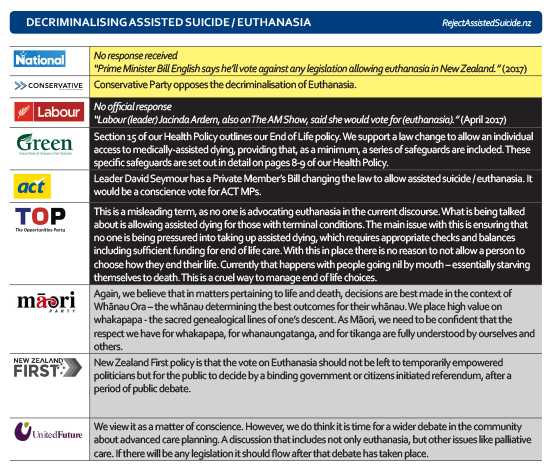

The international evidence backs up these concerns, and explains why so few countries have made any changes to the law around this issue. There are contradictory messages when society rightly wants to take a zero-tolerance approach to suicide, yet at the same time wants to approve a person taking their life. The potential for abuse and flouting of procedural safeguards is a further strong argument against assisted suicide.

The solution is to ensure a palliative care regime that is fully funded and world class. That’s where the politicians’ focus should be. The recent inquiry into assisted suicide / euthanasia had 16,000+ submissions (80% of all submissions) opposing assisted suicide / euthanasia.
READ MORE: www.RejectAssistedSuicide.nz

(click on image/s to download PDF)


Specialist to enhance palliative services at hospice in Nelson

By | Recent News

Stuff co.nz 28 August 2017
Family First Comment: Care – not killing.
Hospice is often thought of as a final refuge; a place where people spend their last days.
But as the service evolves it is offering much more than that.
Nelson Tasman Hospice’s first palliative medicine specialist Dr Jodie Battley said late-stage care was still a core part of the service, but it was now involved with patients much earlier.
That allowed staff to build relationships with patients and their families.
“The big message is that we can help you live well with limited time, it’s all about quality of life.”
Battley said the research showed that early integration of palliative care with oncology and other services meant better outcomes for people.
“These patients do better in terms of quality of life, symptom control and satisfaction with their care.”
READ MORE: https://www.stuff.co.nz/nelson-mail/news/96076740/specialist-to-enhance-palliative-services-at-hospice-in-nelson
twitter follow us

‘Value Your Vote’ Election Resource Launched

By | Media Releases

Media Release 13 Aug 2017
For the fourth successive election, Family First NZ has launched their Value Your Vote resource to inform voters leading up to the September election.

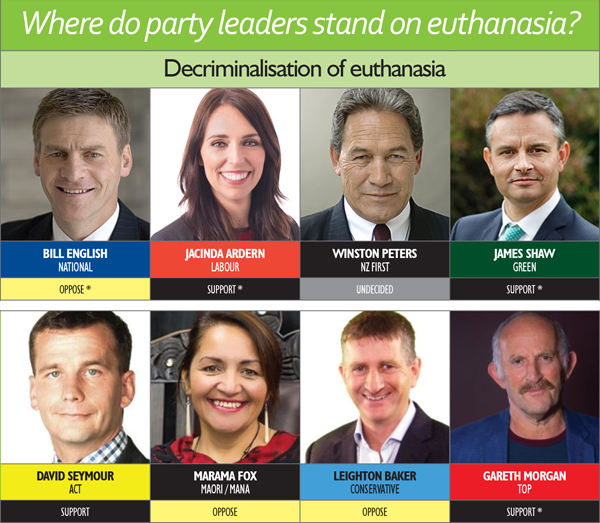
Value Your Vote records how existing MP’s have voted over the past five terms on controversial issues with a focus on votes related to marriage, parenting, and other key social issues. It also makes an important projection on how existing MPs are likely to vote on the upcoming euthanasia and medicinal marijuana bills,” says Bob McCoskrie, National Director of Family First NZ.

“We believe that the issues of the economy, education, health, housing, and law and order are significant. But focusing on economics and other issues while ignoring social values will actually make society’s present problems worse, not better. Research proves that the strength of marriage and family has a major impact on the strength of our nation and the rates of child poverty, child abuse, costs of welfare, and an ordered civil society. Over the past 15 years, there have been a number of law changes voted on by our politicians specifically impacting the welfare of Kiwi families and the role of parents. Marriage has been increasingly devalued.”

There is also a survey of the party leaders’ views and voting intentions on 38 issues including the definition of marriage, income splitting, decriminalisation of abortion, euthanasia & marijuana, ‘gender identity’ in schools, Easter trading laws, same-sex adoption, paid parental leave, broadcasting standards, and many more.

“In a new feature for this election, we have asked all the major parties what their official party policy is regarding the crucial issues of marriage, the anti-smacking law, abortion, euthanasia, marijuana, gender ‘identity’, sex education in schools & parental notification, and others,” says Mr McCoskrie.

This resource was available at the last election in 2014 (and also in 2011 & 2008) and was very popular with over 100,000 page views on the website, and more than 150,000 brochures distributed throughout the country. 80,000 copies have already been ordered.

“Family First New Zealand does not endorse or oppose candidates or parties for elective office, but this resource offers an important perspective on each candidate and party in matters important to families. We are pleased to offer this guide as a helpful resource to aid you in making an informed decision when you vote this September.”

DOWNLOAD THE 16-PAGE PAMPHLET
OFFICIAL WEBSITEwww.ValueYourVote.nz

Voluntary euthanasia bill won't be debated before election

By | Recent News

TVNZ One News 10 August 2017
Family First Comment: Oh dear. How sad. Never mind. We will survive  😊
http://www.rejectassistedsuicide.nz
David Seymour’s voluntary euthanasia bill won’t be debated before parliament is dissolved on August 22.
Yesterday was the last member’s bill day before dissolution and it was nowhere near the top of the agenda for a first reading.

When the End of Life Bill bill was drawn from the ballot in June Mr Seymour suspected there would be delaying tactics.
He knew neither of the main parties wanted the polarising, controversial issue of voluntary euthanasia to get in the way of their election campaigns.
“I suspect you will find MPs will find enormous passion for enormously important bills they’ve previously never heard of,” he said.
The bill proposes allowing voluntary euthanasia under strict conditions.
Whether it gets past it’s first reading will be decided by a conscience vote in the next parliament.
https://www.tvnz.co.nz/one-news/new-zealand/voluntary-euthanasia-bill-wont-debated-before-election

signup-rollKeep up with family issues in NZ.
Receive our weekly emails direct to your Inbox.

Simon O'Connor: Why we didn't back euthanasia bill

By | Recent News

NZ Herald 10 August 2017
Family First Comment: Superb commentary. Thank you Simon.
Throughout this term of Parliament it has been my privilege to serve as chair of the health committee. Over the last two years, it has been my responsibility to lead the inquiry into assisted suicide and euthanasia as requested by a petition to Parliament.

I led a group of dedicated MPs from a cross-section of parties in listening to what New Zealanders had to say about this difficult but important subject. I felt it was essential that I maintained an unbiased, even-handed process, though I made no secret of my own personal concerns about the topic.

From the outset, I believed it was important for all those concerned to know my opinion so that they could watch me and ensure that I behaved in a fair manner towards all sides and I have appreciated the statements by MPs and by the petitioner acknowledging my professional impartiality.

Over 21,000 New Zealanders wrote to the committee with their own thoughts on assisted dying and euthanasia. Of those, 944 people spoke to us in person over 108 hours of hearings. This inquiry was the largest ever undertaken by a New Zealand Parliament and was the largest, most public discussion ever held on this topic.

Now that the investigation is complete, now that all of the submitters have been heard, and the report has been written by the health committee as a whole, I feel I can finally say a few words myself.
Before entering Parliament I spent years studying ethics and philosophy at university, particularly around human rights. Some might see these fields as impractical but they prepared me well for this investigation. My extensive readings, lectures, and discussions formed the basis of my objection to assisted suicide.

I entered this investigation willing to hear evidence from all sides and was prepared to consider new arguments if they were presented. Unfortunately, the arguments in favour of assisted suicide and euthanasia are not terribly well-reasoned. They rely heavily on emotional experiences and intense ideologies. These are not the best foundations for building laws, but they are important and they do deserve to be heard.
READ MORE: http://www.nzherald.co.nz/nz/news/article.cfm?c_id=1&objectid=11900872

twitter follow us